
Library Bans & Black Books: Inside the Ongoing Fight for Literary Freedom
3 min read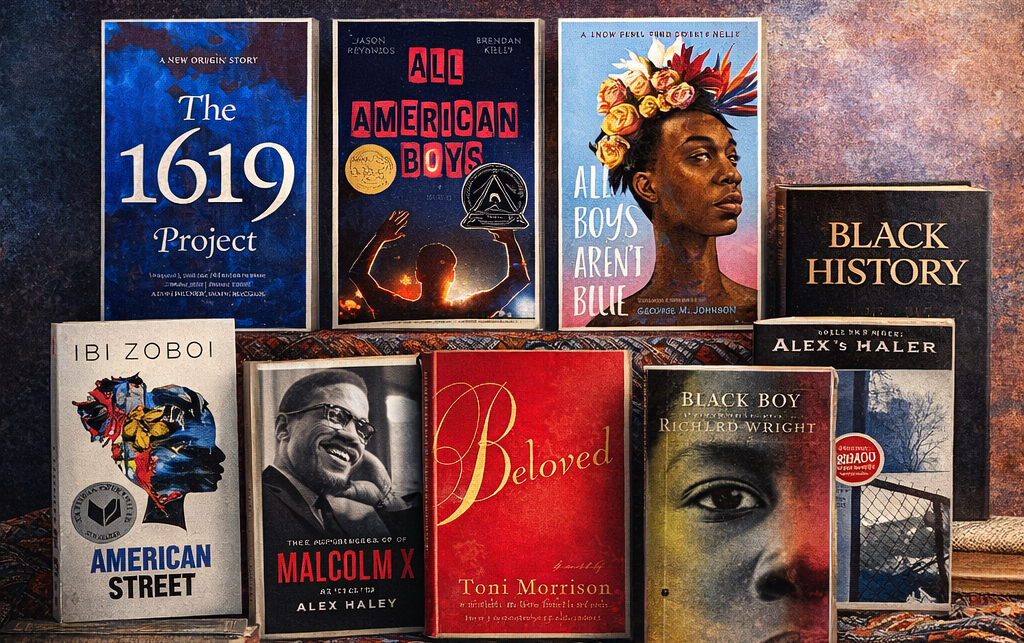
Book bans in America are not new.
What is happening now feels coordinated, targeted, and louder than it has in decades. Across school districts and public libraries, books by Black authors are being challenged, removed, or restricted at a rising rate. The justification is often framed as protecting children, but the pattern tells a more complicated story.
The real question extends beyond why these books are being banned. It also comes down to who is pushing back and what progress is being made.
Happening Right Now
According to the American Library Association, thousands of book challenges have been reported across the United States in recent years, with numbers reaching levels not seen in decades.
The targets are not random.
Books that focus on
- Race and systemic inequality
- Black history
- Identity and lived experience
appear on challenged and banned lists at disproportionate rates.
Some of the most frequently challenged titles include
- The Bluest Eye by Toni Morrison
- All American Boys by Jason Reynolds
- The Hate U Give by Angie Thomas
- Stamped: Racism, Antiracism, and You by Ibram X. Kendi
These are widely recognized works that continue to appear in classrooms and libraries, which makes their removal especially significant.
The Legal Battlefield: Are There Any Real Wins
Public conversation often swings between extremes, framing the situation as either complete loss or total victory. The reality is more complex.
Case Example: Florida
A federal judge signaled that removing books based on disagreement with their ideas may violate First Amendment protections. The decision does not end the issue, but it establishes clear limits on how far restrictions can go.
Case Example: Texas
In Little v. Llano County, a federal judge ordered previously removed books to be returned to library shelves. The ruling reinforced that disagreement with a book’s content is not a sufficient reason for removal.
These rulings reflect meaningful legal movement.
At the same time,
- Appeals are ongoing
- Some rulings are temporary
- Policies continue to shift at the local level
The legal landscape continues to evolve as new cases emerge.
Black Books Keep Showing Up on These Lists
Because books by Black authors often
- Address difficult historical realities
- Challenge dominant narratives
- Center perspectives that have been historically excluded
That combination gives these works cultural weight and visibility. It also places them at the center of ongoing debates about education and access.
A book like The Hate U Give offers more than a story. It presents a perspective shaped by lived experience, which is exactly what makes it impactful and, in some spaces, controversial.
The Frontline: Who Is Fighting Back
The response is being shaped by people working at every level.
- Librarians maintaining access to collections
- Advocacy groups filing legal challenges
- Authors speaking publicly about censorship
- Communities organizing around access to information
Organizations such as the American Civil Liberties Union continue to challenge removals that raise constitutional concerns, while the American Library Association tracks data and supports those navigating these challenges.
This work reflects a broader commitment to maintaining access to literature and preserving the role of libraries as open spaces for learning.
What Happens Next
Legal challenges are continuing, with outcomes being shaped in real time.
Future developments will likely include
- Additional court rulings
- Continued debates at the local level
- Expanded efforts from authors and independent platforms
- Ongoing community advocacy
Even when books return to shelves, the effects of removal can linger through reduced visibility and hesitation around inclusion.
The fight for literary freedom is happening now in school board meetings, in courtrooms, and in libraries, and increasingly in public conversations where access to information is being debated in real time. The outcome will shape not just what people read, but what stories are allowed to exist and whose voices are given the space to be heard.